
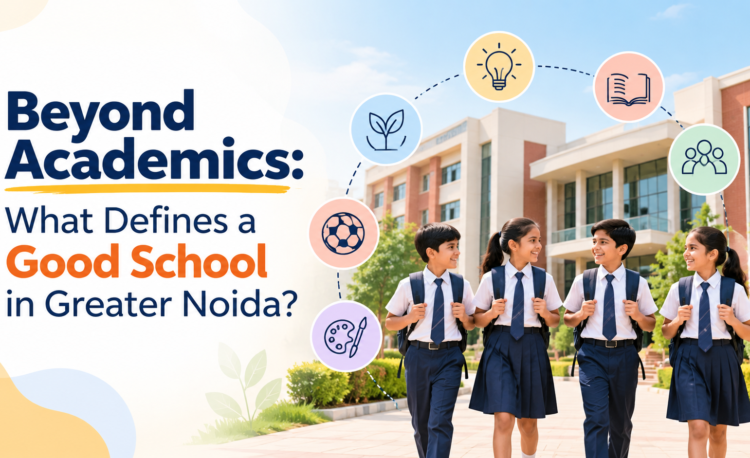
As a parent, you want your child to achieve good results. You also want them to speak confidently, ask thoughtful questions, and learn to manage challenges. As such, when you search for a Top School in Greater Noida for your child, you’d naturally want the school to fulfil these expectations. And why not! Academic achievement definitely matters, but it should sit alongside opportunities for children to become curious, capable, responsible, and successful in life.
However, many parents often face difficulty in finding the right school for their children as they do not know what to look for beyond a report card or campus brochure. A school’s approach becomes clearer when you consider how children learn, participate, and receive support each day. From classroom discussions to friendships and creative activities, the whole experience matters.
But how do you recognise such a school for your child? Here are a few steps you can follow to identify the school that supports your child’s progress as a learner and an individual.
What Makes a School a Good School in Greater Noida?
· Strong Academics with Conceptual Learning
The primary purpose of school education is providing students with a strong academic foundation. However, the top school is the one where children also know why an answer makes sense. Memorisation has its place, but understanding allows them to use knowledge in unfamiliar situations.
Must Read https://krmangalamgn.com/blog/the-importance-of-concept-based-learning-in-todays-competitive-world/
· Skills That Prepare Children for the Future
Applying knowledge also calls for critical thinking, communication, creativity, and collaboration. Besides making students academically sound, a school should also teach them skills to compare ideas, explain choices, and share responsibilities. Digital awareness adds another layer. These skills strengthen subject learning through regular practice.
Holistic Development Beyond the Classroom
Classroom learning reveals only some of a child’s strengths. Other settings give them different ways to participate and discover what interests them.
· Sports and Physical Development
Regular physical activity gives children opportunities to build fitness and active habits. Team games offer practice in cooperation, discipline and perseverance.
· Arts, Culture, and Creative Expression
Music, performing arts, and visual arts offer ways to explore ideas and express feelings. A child who hesitates during a classroom discussion may enjoy telling a story through drawing or drama. Hence, arts, culture, and creative expression must be given due importance in a child’s holistic development.
· Leadership and Student Participation
Leadership can begin with organising materials, introducing a performance or helping a group reach a decision. Public speaking and student-led activities give children opportunities to take responsibility.
A Top School Nurtures Confident and Resilient Children
Children are more likely to use these opportunities when they feel respected and know where to turn for help. Hence, the top school is the one that also focuses on the below-listed elements:
· Emotional Well-Being and a Supportive Environment
A safe environment includes respectful relationships and a clear response to concerns. When a child experiences disappointment, adults should help them understand what happened and consider a next step. Ask how the school handles exclusion, bullying reports, and requests for emotional support.
· Encouraging Independence and Responsibility
Age-appropriate decisions allow children to practise taking ownership. A younger pupil might organise their bag; an older student might plan a project schedule. Learning from mistakes requires guidance and chances to try again. Confidence can grow through completing manageable responsibilities.
· Positive Teacher-Student Relationships
Individual attention begins with noticing how a child learns and participates. Open communication helps teachers understand different learning needs. Constructive feedback should explain what worked and what to improve.
Learning Should Connect Children with the Real World
Supportive teaching gives children the confidence to explore. The next step is helping them connect classroom ideas with situations beyond a textbook. The top schools do it by including the following in their pedagogy:
· Experiential and Project-Based Learning
Projects and activities should have a clear learning purpose. Investigating water use, for example, can connect measurement with environmental questions. Exploration and experimentation become useful when children explain their observations, test ideas, and reflect on what they have learnt.
· Life Skills and Problem-Solving
Working on a shared task involves more than producing an answer. Children must communicate, collaborate, manage time, and make decisions. These ordinary challenges create opportunities to practise life skills within meaningful learning.
· Preparing Students for a Changing World
Technology and innovation should encourage thoughtful exploration. Students need opportunities to evaluate information, adapt when an approach fails, and consider different perspectives. Global awareness can begin with comparing everyday experiences across communities while learning to discuss differences respectfully.
What Should Parents Look For When Choosing a Top School in Greater Noida?
These qualities become easier to assess when you look at the whole learning experience alongside examination results and rankings.
· Look Beyond Academic Results
Ask how teachers develop understanding and independent thinking.
· Look at the Whole Child
Consider academic, physical, emotional, and social development together. Ask whether your child would have realistic opportunities to participate and receive support in that environment.
· Look at the Student Experience
Observe classrooms, activities, teacher interactions, and campus life. With these criteria in mind, you can explore how a particular school brings them together.
Why K.R. Mangalam World School Greater Noida Reflects These Qualities
· Learning Beyond Textbooks
The pedagogy at K.R. Mangalam World School, Greater Noida, works around project-based learning that teaches children to connect concepts taught in class with practical tasks.
· Opportunities for Holistic Growth
The school provides sports provision alongside music, dance, theatre, and visual arts. Its art programme also includes public speaking. These opportunities offer settings for participation and expression.
· Preparing Students for the Future
The school’s educational approach highlights STEAM learning, emerging technologies, and critical thinking. These priorities connect with creativity and problem-solving.
· A Learner-Centred Environment
Facilities include smart classrooms, scientific laboratories, a well-furnished library, arts spaces, sports areas, and much more. The school encourages all of its students to participate in age-appropriate activities and extend support for individual learning needs.
Beyond Academics, What Truly Makes a School Stand Out?
A school stands out when academic strength and conceptual learning connect with the rest of a child’s development. Sports, creative opportunities, and leadership help children explore their strengths. Emotional support and approachable teachers help them navigate setbacks. Experiential learning, life skills, and purposeful learning spaces give knowledge a practical context.
When these elements work together, children gain opportunities to develop confidence and prepare for an evolving world. This broader approach is what K.R. Mangalam World School, Greater Noida, seeks to bring to school education. For parents identifying a top school in Greater Noida, a campus visit offers a useful next step: see how these priorities become part of a child’s everyday experience.
Frequently Asked Questions (FAQs)
Q. What makes a school stand apart from the rest?
Strong teaching, conceptual learning, varied activities, and accessible support matter together. Look for evidence of how children learn and participate each day.
Q. Why should parents look beyond academic results when choosing a school?
Results show one aspect of progress. Confidence, relationships, physical development, and practical skills also shape a child’s school experience.
Q. How can parents assess a school beyond its academic performance?
Visit classrooms and activity spaces, discuss support with teachers and ask for specific examples. Include your child’s observations before deciding