
Introduction
When kids return home from school, parents usually ask how their day went and what they learned. While much of the focus is given to visible learning, such as finishing a chapter, learning a new concept, conducting an interesting lab experiment, etc., it often happens that the most crucial learning aspects are overlooked.
We’re talking about the real-world skills that children silently develop through daily school experiences, interactions, and activities. These aren’t ordinary skills, but real skills that will help your kids thrive in their adulthood.
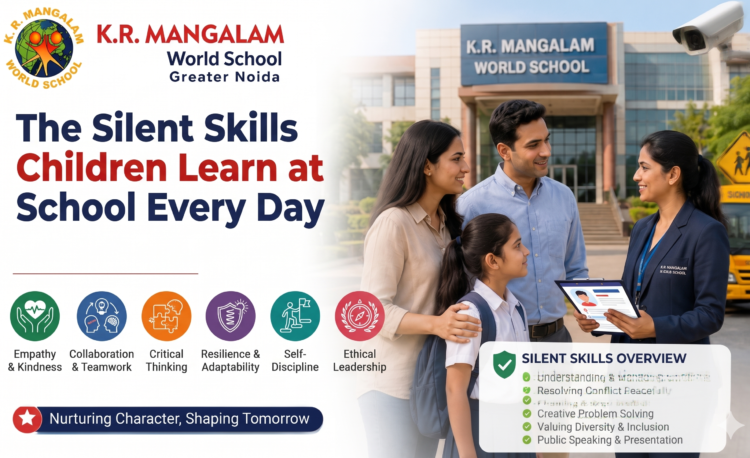
In this blog post today, we at K.R. Mangalam World School, Greater Noida, one of the top school in Greater Noida, have shared some of the key silent skills that children usually learn at school every day. Knowing these skills will help you realise that your child’s growth isn’t limited to academic progress alone. So, let’s quickly start exploring the silent skills shared below.
- Emotional Regulation
One of the most valuable silent skills children develop in schools is the ability to manage emotions without becoming overwhelmed by them. At K.R. Mangalam World School, Greater Noida, we make students undergo different situations where they experience varied emotions.
For example, a student may participate in a race and lose. In this case, the student will naturally feel sad. Similarly, a student can feel stressed if they struggle to finish a project by the assigned deadline. However, these experiences gradually teach children to get over the fears and challenges and put in more effort towards achieving their goals. This is when they begin moving towards success and victory. These experiences slowly teach children how to embrace their emotions and process them properly.
This skill is incredibly relevant for children as it aids their growth into adults who can handle stress, workplace pressure, criticism, and setbacks more constructively.
- Adaptability to Changing Environments
Every child today must develop adaptability as they’re growing up in a fast-changing world where everyone is struggling to keep up with the changes. Thankfully, school-going kids don’t have to make extra effort to learn this valuable skill.
If you closely monitor your child’s school journey, you’ll notice they undergo countless experiences that require them to become adaptable. Moving to a new class, adjusting to a new teacher, following a revised routine, and working with unfamiliar classmates are all activities that expose students to changing expectations and environments. It teaches them how to function even when things feel unfamiliar or uncomfortable. This one skill can significantly contribute to your child’s success as they step into their higher study and work phase.
At K.R. Mangalam World School, Greater Noida, we firmly believe that adaptability develops when children are exposed to both comfortable and not-so-comfortable experiences. But this is when they need the guidance of adults to guide them onto the right path. This is exactly what we do at our school. Our teachers are always available to guide and mentor our students to help them find their way through challenges.
- Time Management & Task Prioritization
The top schools in Greater Noida silently introduce children to time management long before they fully understand productivity. If you look closely, you’ll find that most of the students today know how to multitask and manage their homework, projects, exams, extracurricular activities, social life, and a lot more.
When students are constantly juggling multiple responsibilities, they gradually learn the art of time management and task prioritisation. What makes this skill powerful is that it develops through real consequences rather than theory.
A forgotten assignment or rushed preparation will teach a lasting lesson in time management and task prioritisation – something they cannot learn by simply being told. This is actually an excellent skill to possess because it significantly improves work performance, stress management, and personal discipline.
- Social Intelligence
School is one of the first places where children regularly interact with people outside their immediate family for long hours every day. Whether through friendships or regular classroom discussions, teamwork or disagreements, children slowly learn how to understand:
- Different personalities
- Social boundaries
- Communication styles
- Group dynamics
- The pulse of their surroundings
- Social cues
Over time, students build sharp social intelligence that guides them when to speak, when to listen, how to speak, and how to navigate peer pressure. This social intelligence helps students become excellent leaders, networkers, and communicators.
- Independent Decision-Making
While parents and teachers make most of the visibly important decisions for students, especially for young children, students still make countless small decisions in their everyday school life. They decide:
- How to complete assignments
- Whom to spend time with
- How to respond during disagreements
- Whether to participate in activities
- How seriously to take responsibilities
These are a few small decisions that every student makes in their day-to-day school life. Although these decisions appear small, they’re helping students build their decision-making muscles. Over time, as students continue to make repeated decisions for themselves, there will come a point in time when they become fully equipped to make major life decisions confidently.
Frequently Asked Questions (FAQs)
- Why are silent skills important for children?
Silent skills are important because they equip children with the mindset, behaviour, and wisdom needed to succeed in the real world.
- Can children develop silent skills at home?
They can, but the development will be very limited. Schools provide the best environment for developing silent skills because they’re designed to provide daily structured exposure to situations that naturally build these abilities.
- Are silent skills connected to academic performance?
Not directly. Silent skills, particularly time management and resilience, help students improve their focus and consistency. It, in turn, improves their academic performance.
- How can parents support the development of silent skills?
As a parent, you can help your kids develop silent skills by giving them problem-solving and decision-making tasks in a controlled environment. You should start avoiding overprotecting them, so they can learn to face challenges independently.
Conclusion
Once children start their school journey, they learn a lot as they progress. Unfortunately, most of their progress is measured only by grades, not the skills they develop alongside their academic growth.
We at K.R. Mangalam World School, Greater Noida, one of the top school in Greater Noida, very firmly believe that equal emphasis must be laid on academic growth and real-life skill development. It’s a key reason why our students don’t just develop silent skills, but they also hone them over time with teachers’ guidance.