
Key Highlights
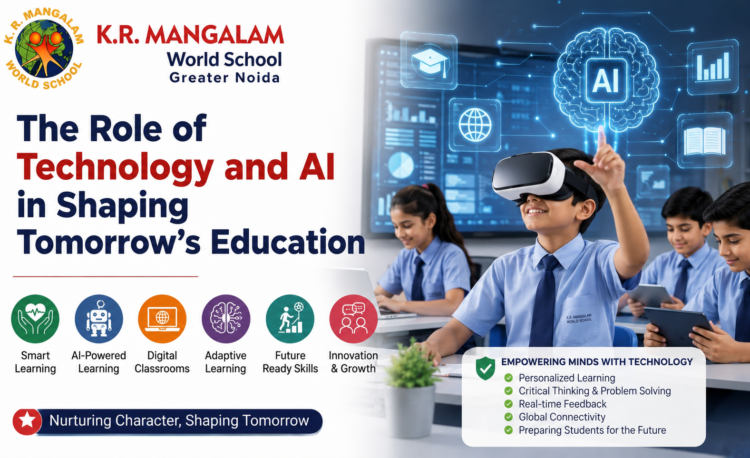
- Technology makes learning visual, interactive and relevant.
- AI can support personalised practice and timely feedback.
- Robotics and coding strengthen creativity and problem-solving.
- Teachers remain mentors, facilitators and ethical guides.
- Digital citizenship promotes safe, responsible technology use.
Table of Contents
- Introduction
- About Us
- Technology-Enabled Learning
- Personalised Learning Through AI
- Future-Ready Skills
- Responsible AI Use
- Conclusion
- FAQs
Introduction:
Education is entering a new phase in which textbooks, classroom discussions and practical experiences are supported by digital tools. At K.R Mangalam World School Greater Noida, the Top School in Greater Noida where these interactive displays, simulations, learning platforms, coding applications and virtual resources help students explore concepts instead of merely memorising them. Families searching for a school now look beyond computer facilities; they expect technology to improve understanding, participation and independent thinking.
About Us:
KR Mangalam School follows a future-focused philosophy connecting academic knowledge with design, innovation and practical exploration. Its official framework highlights STEAM, robotics, AI, programming, Python, machine learning, 3D printing, drones and product design. These opportunities encourage learners to create solutions rather than consume technology passively.
Classroom Transformation at a Glance
| Traditional Practice | Technology-Enabled Approach | Student Benefit |
| One explanation for everyone | Multimedia and adaptive practice | Better clarity |
| Passive note-taking | Simulations and digital projects | Higher engagement |
| Delayed evaluation | Immediate feedback | Faster improvement |
| Isolated subjects | Interdisciplinary STEAM tasks | Real-world application |
| Technology consumption | Coding and robotics | Creativity and confidence |
How Does Technology Make Learning More Meaningful?
Digital learning becomes valuable when it helps children see, test and apply ideas. A science simulation can demonstrate an invisible process, while virtual maps make geography more contextual. Interactive assessments also help teachers check understanding during a lesson.
Useful classroom practices include:
- Visual explanations for difficult concepts
- Digital quizzes for quick assessment
- Collaborative presentations and research
- Virtual experiments before laboratory work
- Projects combining art, mathematics and science
The purpose is not entertainment. It is to help learners ask stronger questions, connect subjects and remember concepts through active participation.
How Can AI Support Personalised Learning?
Every learner progresses differently. AI-supported systems can analyse responses, recommend suitable practice and highlight areas requiring teacher support. Advanced learners can attempt challenging tasks, while others receive step-by-step reinforcement.
CBSE provides Computational Thinking and Artificial Intelligence resources for Classes III to VIII, along with AI curriculum support for higher classes, showing that AI literacy is entering mainstream school education. Still, data should never become a fixed label. Teachers must interpret digital insights thoughtfully and consider effort, behaviour and individual context.
Which Future-Ready Skills Do Digital Programmes Develop?
Technology education is strongest when students become creators. Coding, robotics, game design and engineering challenges teach them to convert ideas into workable models. During such projects, learners practise:
- Computational and logical thinking
- Creativity and design thinking
- Teamwork and communication
- Experimentation and resilience
- Research and information evaluation
- Presentation and entrepreneurial thinking
These experiences connect classroom learning with emerging careers while developing adaptability—the ability to learn and apply knowledge in unfamiliar situations.
How Can Schools Ensure Responsible AI Use?
AI-generated content may be inaccurate, biased or unsuitable for a learner’s age. UNESCO recommends a human-centred approach that protects agency, inclusion and ethical decision-making. Schools must therefore teach students when to use AI, how to verify outputs and why original thinking matters.
A responsible framework should include:
- Age-appropriate usage guidelines
- Student data and privacy protection
- Verification through credible sources
- Disclosure of AI-assisted work
- Teacher review and academic honesty
- Balanced screen time and offline collaboration
This approach builds digital citizenship and prevents technology from becoming a shortcut that weakens curiosity.
Conclusion:
Technology and AI can make education more personalised, practical and future-focused, but their value depends on thoughtful implementation. When digital tools support strong teaching, hands-on exploration and ethical awareness, students learn to use innovation with purpose. A future-ready school develops curious learners who can create, collaborate, evaluate information and remain confident in a changing world.
FAQs:
Q1. How does the school use AI to improve student learning experiences?
AI-based tools support personalised learning, better assessments and deeper understanding of concepts.
Q2. Can technology prepare students for future career opportunities?
Yes, digital learning helps learners develop essential skills like innovation, problem-solving and adaptability.
Q3. How does the institution balance AI with traditional teaching methods?
It combines advanced technology with teacher guidance to create meaningful learning experiences.
Q4. Why is technology integration important in modern education?
It makes learning more interactive, practical and aligned with future requirements.
Q5. Does the school focus on responsible use of technology?
Yes, students are encouraged to use digital tools ethically and thoughtfully.
Q6. How does AI support personalised education?
AI helps identify learning needs and provides customised support for individual progress.