
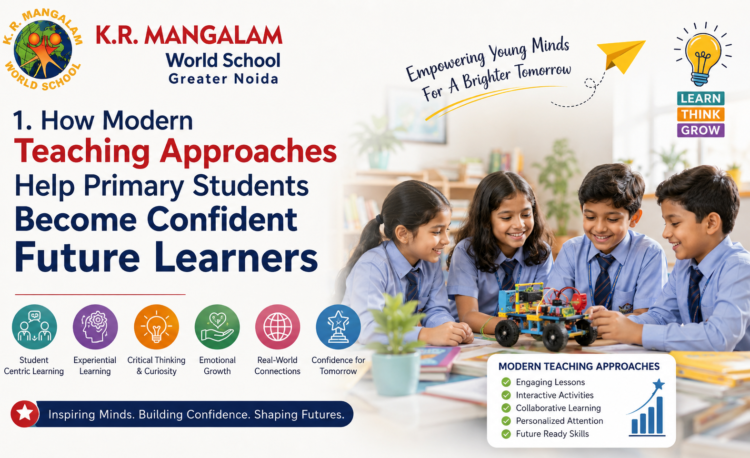
Key Highlights
- Modern teaching moves primary education beyond textbook-based learning.
- Experiential and activity-based methods encourage curiosity and participation.
- Collaborative learning helps children communicate and work confidently with peers.
- Technology, coding and practical activities introduce future-ready skills.
- Formative assessment helps teachers understand individual learning needs.
- Social-emotional learning supports resilience, empathy and responsible decision-making.
Table of Contents
- Introduction
- About Us
- How Does Experiential Learning Build Confidence in Primary Students?
- Why Is Collaborative Learning Important for Future-Ready Learners?
- How Do Technology and Skill-Based Activities Prepare Children for the Future?
- How Does Personalised Assessment Support Every Learner?
- Conclusion
- FAQs
Introduction
Primary education is a crucial stage when children begin developing the habits, attitudes and learning skills that influence their future academic journey. At this age, education should not be limited to memorising facts or completing worksheets. At KR Mangalam World School, Greater Noida learning is designed to encourage children to ask questions, explore ideas, participate in activities and understand concepts through meaningful experiences. As a Top Primary School in Greater Noida, the institution focuses on modern teaching approaches that nurture active, curious, expressive and confident learners who are prepared to take on new challenges.
About Us
KR Mangalam World School, Greater Noida focuses on creating an engaging and supportive learning environment where children can discover their abilities while developing strong academic and life skills. Its primary programme combines conceptual learning with coding, robotics, financial literacy, arts, physical education and life skills. The institution also promotes group learning, formative assessment and opportunities for students to participate in competitions and collaborative activities. This balanced approach supports curiosity, communication, creativity and independent thinking, helping children become prepared for future stages of education.
How Does Experiential Learning Build Confidence in Primary Students?
Experiential learning allows children to understand concepts by doing, observing and experimenting rather than simply memorising information. When a mathematics concept is connected to a practical activity or a science lesson involves experimentation, students can understand how classroom knowledge relates to everyday situations. This makes learning more meaningful and encourages children to participate without constantly worrying about making mistakes.
- Encourages children to ask questions and explore answers.
- Connects classroom concepts with practical experiences.
- Makes difficult concepts easier to understand.
- Builds confidence through active participation.
- Develops problem-solving and critical-thinking abilities.
Why Is Collaborative Learning Important for Future-Ready Learners?
Children do not learn only from teachers; they also learn through interaction with classmates. Collaborative activities encourage students to listen to different viewpoints, explain their own ideas and work towards a shared outcome. These experiences gradually develop communication, teamwork and interpersonal skills that are valuable both inside and outside the classroom.
- Improves communication and active listening.
- Encourages teamwork and cooperation.
- Helps students respect different opinions.
- Creates opportunities for leadership.
- Builds confidence in speaking and presenting ideas.
How Do Technology and Skill-Based Activities Prepare Children for the Future?
Technology is becoming an integral part of modern education, but its greatest value comes when it is used purposefully. Digital tools can make lessons more interactive while exposing children to new ways of researching, creating and solving problems. Alongside technology, skill-based learning gives students opportunities to understand how knowledge can be applied beyond traditional academic subjects.
- Introduces children to emerging technologies.
- Develops computational and logical thinking.
- Encourages creativity through STEAM activities.
- Builds practical awareness through life skills.
- Helps students become comfortable with new learning tools.
Must Read – https://krmangalamgn.com/blog/integrating-technology-creativity-and-values-into-everyday-education/
How Does Personalised Assessment Support Every Learner?
Every child learns differently. Some students may understand a concept quickly, while others may need additional explanation, practice or a different learning activity. Modern assessment therefore needs to look beyond marks and identify how a child is progressing, where support is required and which areas need further development.
- Identifies individual strengths and learning gaps.
- Allows teachers to modify instructional strategies.
- Reduces excessive dependence on exam scores.
- Encourages students to understand their own progress.
- Supports steady academic and personal development.
Conclusion
Modern teaching approaches can transform primary education into a journey of discovery, participation and confidence-building. At KR Mangalam World School, Greater Noida, the experiential activities, collaboration, technology, skill development and personalised assessment enable children to understand concepts while developing the abilities needed for lifelong learning. These methods also encourage children to become more independent, communicative and resilient learners.
FAQs
- How does KR Mangalam World School make primary learning more engaging?
Experiential and activity-based learning encourages curiosity, participation and confidence. - How does the school prepare children for future learning?
Collaborative activities develop problem-solving and digital skills. - Why is experiential learning valuable for young learners?
It connects classroom concepts with practical experiences, making learning easier to understand. - Q. What does India’s national curriculum framework say about how young children should learn?
The National Curriculum Framework for Foundational Stage treats play and hands-on exploration as central to learning for children aged 3 to 8. It also favours regular, supportive assessment over heavy reliance on tests, which is the approach modern primary classrooms are moving towards.