
Introduction:
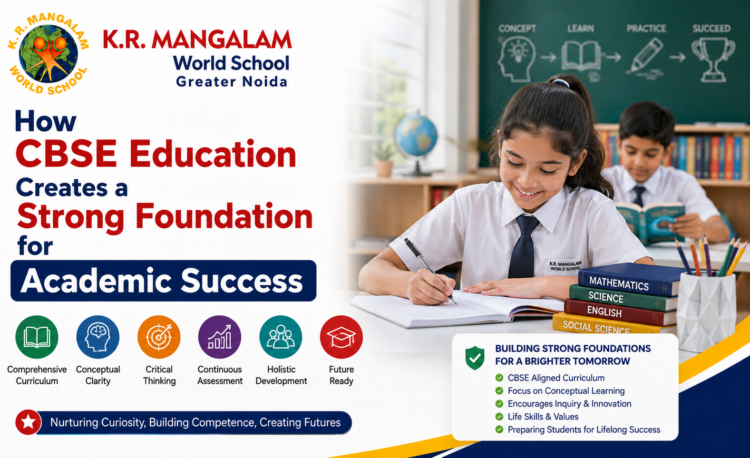
Every parent wants their child to develop strong academic skills, but academic success is not built by memorising chapters alone. It starts much earlier—with clear concepts, curiosity, regular practice and the confidence to apply what has been learned.
At KR Mangalam World School, Greater Noida, this is one reason CBSE education continues to attract families looking for a structured yet progressive approach to schooling. The curriculum places emphasis not only on subject knowledge but increasingly on competencies, application, creativity and holistic development.
For parents comparing the Top 10 CBSE Schools in Greater Noida, understanding how the curriculum builds these foundations can make the decision more meaningful. Here is what to look for.
Start With Strong Concepts, Not Just Memorisation
A strong academic foundation begins when children understand why something works rather than simply remembering the answer.
CBSE learning across subjects can give students opportunities to build concepts progressively. Mathematics, science, languages and social sciences become more useful when learners are encouraged to connect classroom knowledge with familiar situations.
Instead of asking children to remember everything for a test, an effective classroom can encourage them to:
- Understand concepts clearly
- Ask questions
- Relate subjects to everyday experiences
- Practise and apply what they learn
- Develop independent thinking
This approach is particularly valuable during the foundational and preparatory years, when children are developing core literacy, numeracy and learning habits. CBSE guidance also emphasises age-appropriate, experience-based learning and holistic development during these stages.
Can Experiential Learning Improve Academic Understanding?
Yes—and this is where a classroom can become much more engaging.
Children often remember an experience more easily than a definition. Projects, experiments, demonstrations, field-based tasks and creative activities can help learners see how different concepts work in real situations.
The school’s educational approach places strong emphasis on skill-based curriculum and competency-based pedagogy, with the stated aim of keeping learners actively and joyfully engaged. Its broader learning philosophy is organised around Learn, Explore, Innovate and Evolve.
Its programmes include STEAM, engaging communication, language and literature, art integration, creativity and media and information learning. These experiences can help students connect academic ideas with practical skills.
Experiential learning can help students:
- Retain concepts for longer
- Develop problem-solving abilities
- Make connections across subjects
- Learn through observation and practice
- Become more confident in applying knowledge
How Does Assessment Support Better Learning?
Assessment should not only tell students what they scored. It should help them understand where they are progressing and where they need more support.
CBSE’s current curriculum guidance emphasises formative and competency-based assessment, including methods that assess conceptual understanding, creativity and higher-order capacities. It also recognises the importance of monitoring individual progress rather than simply comparing students with peers.
A supportive assessment approach can help students:
- Identify areas for improvement
- Understand their strengths
- Receive timely feedback
- Develop self-reflection
- Prepare more effectively for future academic demands
This can make assessment a part of learning rather than something that only happens at the end of a chapter or term.
Should Academic Success Include More Than Marks?
Absolutely.
A child’s academic journey becomes stronger when intellectual growth is balanced with emotional, social and personal development.
The school’s stated aim is to create self-motivated future learners with leadership skills, emotional intelligence and tolerance. Its programmes include socio-emotional and ethical learning, leadership, goal setting, which focuses on developing the whole person across intellectual, personal, social and emotional dimensions.
These qualities can influence how students deal with pressure, cooperate with classmates, respond to setbacks and take responsibility for their learning.
What Should Parents Look for in a CBSE School?
Choosing among the CBSE Schools should involve more than checking examination results or infrastructure.
Parents can consider whether the school provides:
- Strong conceptual teaching
- Competency-based and experiential learning
- Opportunities for communication and creativity
- Purposeful technology exposure
- Regular and meaningful assessment
- Leadership and life-skill opportunities
- Support for emotional and social development
The right environment should help children become capable learners, not just successful test-takers.
How Can CBSE Education Prepare Students for Future Academic Success?
CBSE education can provide a structured academic foundation while creating opportunities to develop skills that become increasingly important as students move to higher grades.
A curriculum supported by conceptual learning, competency development, practical experiences and continuous feedback can help children transition from learning information to using knowledge.
The broader educational approach here also connects learning with exploration, innovation, leadership and self-awareness. The school’s career and guidance initiatives further focus on helping students understand their abilities, academic goals and future pathways.
That combination can give students a stronger foundation for the more specialised demands of senior school, higher education and beyond.
Conclusion:
A strong CBSE education is not simply about completing a syllabus or preparing for examinations. It is about building the habits, concepts and skills that allow students to keep learning as subjects become more challenging.
At KR Mangalam World School, Greater Noida, when children are encouraged to understand rather than memorise, explore rather than hesitate and apply knowledge rather than simply reproduce it, academic success becomes a gradual outcome of meaningful learning.
The school experience is therefore not only about marks. For parents comparing the Top 10 CBSE Schools in Greater Noida, the right learning environment should help children become curious, capable and confident learners who are ready for whatever comes next.
FAQs:
1. How does CBSE education help build strong academic foundations?
CBSE education focuses on progressive learning, conceptual understanding and the application of knowledge. This can help students develop strong subject foundations as they move to higher classes.
2. Why is competency-based learning important in CBSE education?
Competency-based learning focuses on what students can understand and apply rather than only what they can memorise. It encourages practical thinking, problem-solving and meaningful learning.
3. How does experiential learning improve academic performance?
Projects, experiments and practical activities help students connect concepts with real-life situations. This can improve understanding, retention and the ability to apply knowledge.
4. What role does technology play in modern CBSE learning?
Technology can support interactive lessons, research, logical thinking and innovation when used purposefully. It can also provide exposure to areas such as coding, robotics and digital problem-solving.
5. How does assessment support better academic progress?
Regular assessment helps teachers identify learning gaps and understand individual progress. Constructive feedback can help students improve before challenges become difficult to manage.
6. Is academic success in CBSE education limited to marks?
No. Strong academic development also includes conceptual clarity, communication, creativity, problem-solving, confidence and the ability to apply knowledge in different situations