
Key Highlights
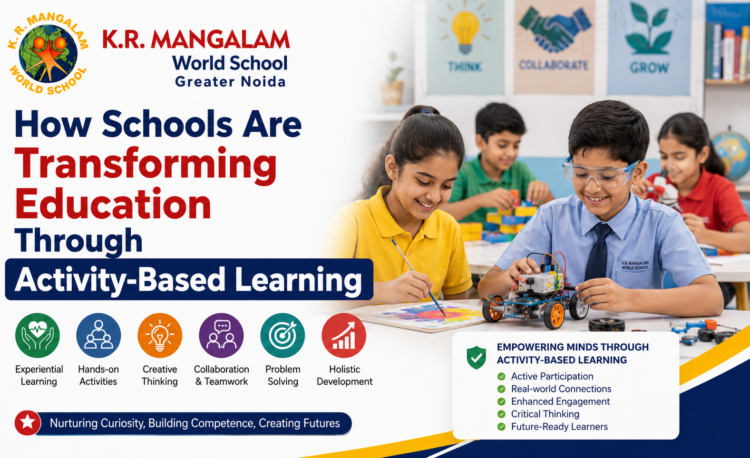
- Activity-based learning encourages practical understanding beyond textbooks.
- Experiential activities improve creativity, confidence and collaboration.
- Real-world projects help students develop problem-solving abilities.
- Interactive learning approaches support holistic student development.
- Modern classrooms focus on skills required for future success.
Table of Contents
- Introduction
- About Us
- How Activity-Based Learning Changes Traditional Education
- Why Experiential Learning Improves Student Development
- How Activities Build Future-Ready Skills
- Role of Teachers in Activity-Based Education
- Conclusion
- FAQs
Introduction:
Education today is moving beyond memorising information and preparing students solely for examinations. At K.R. Mangalam World School Greater Noida, recognised as the Best School in Greater Noida, modern teaching approaches focus on helping children understand concepts, apply knowledge and develop the skills required to face real-world challenges. Activity-based learning has emerged as an effective approach that encourages students to participate in practical tasks, collaborative projects, experiments and creative activities, making the learning process more engaging and meaningful.
About Us:
KR Mangalam School focuses on creating an engaging learning environment where academics are supported by innovation, creativity and practical experiences. The institution follows a learner-focused approach that encourages students to participate in activities, explore new ideas and develop essential life skills. With opportunities in areas such as experiential learning, sports, performing arts, technology and collaborative projects, learners are encouraged to discover their strengths and build confidence.
Learning Approach Comparison
| Traditional Learning | Activity-Based Learning | Student Outcome |
| Teacher-centred lessons | Student participation | Better engagement |
| Memorisation-focused | Concept application | Deeper understanding |
| Limited classroom interaction | Collaborative activities | Improved teamwork |
| Fixed learning methods | Creative exploration | Greater innovation |
| Exam-oriented approach | Skill-oriented learning | Future readiness |
How Does Activity-Based Learning Make Education More Effective?
Activity-based learning transforms classrooms into interactive spaces where students learn by doing. Instead of simply reading about concepts, learners experience them through experiments, discussions, demonstrations and projects.
This approach helps students:
- Understand complex concepts through practical examples
- Develop curiosity through exploration
- Improve observation and analytical skills
- Connect academic subjects with real-life situations
- Retain knowledge for longer periods
For example, a science lesson becomes more impactful when students perform experiments, while mathematics becomes more engaging through problem-solving activities linked with daily experiences. Such methods encourage learners to ask questions and discover answers independently.
Why Is Experiential Learning Important for Student Growth?
Experiential learning allows students to gain knowledge through direct involvement. It creates opportunities where children can experiment, make decisions and learn from outcomes. This develops confidence and prepares them to handle challenges effectively.
Key benefits include:
- Better problem-solving: Students learn to analyse situations and find solutions.
- Improved communication: Group activities encourage discussions and teamwork.
- Enhanced creativity: Creative tasks allow learners to express unique ideas.
- Stronger confidence: Presentations and performances improve self-belief.
- Independent thinking: Students develop the ability to make informed decisions.
According to modern educational frameworks, learning should focus on competency development rather than only information collection. Activity-based methods support this vision by preparing students for practical situations.
How Do Activities Help Students Develop Future-Ready Skills?
The future requires individuals who can adapt, innovate and collaborate. Classroom activities provide a platform where students practice skills that are valuable beyond academics.
Important skills developed through activities include:
| Activity Type | Skills Developed |
| Group projects | Leadership and teamwork |
| Debates and presentations | Communication skills |
| Robotics and technology tasks | Innovation and logical thinking |
| Sports activities | Discipline and coordination |
| Creative arts | Expression and imagination |
These experiences help students become confident individuals who can approach challenges with creativity and resilience.
What Role Do Teachers Play in Activity-Based Education?
Teachers act as facilitators who guide students through meaningful learning experiences. Instead of only delivering information, educators create opportunities for exploration and encourage students to participate actively.
Teachers support activity-based learning by:
- Designing engaging classroom experiences
- Encouraging discussions and teamwork
- Providing constructive feedback
- Connecting activities with academic concepts
- Supporting different learning abilities
A teacher’s guidance ensures that activities are not only enjoyable but also contribute to measurable learning outcomes.
Conclusion:
Activity-based learning is reshaping modern education by making classrooms more interactive, practical and student-focused. It helps learners develop knowledge along with creativity, confidence, communication and problem-solving abilities. As education continues to evolve, schools that integrate experiential methods create environments where students are prepared for academic success as well as future challenges.
FAQs:
Q1. How does KR Mangalam School make classroom learning more engaging?
The school uses hands-on activities, projects and practical experiences to improve understanding.
Q2. Why is activity-based learning becoming popular in modern education?
It helps students connect concepts with real-life situations and develop essential skills.
Q3. How do activities improve student confidence?
Collaborative tasks, presentations and projects encourage communication and self-expression.
Q4. Does the learning approach go beyond textbooks?
Yes, students explore concepts through experiments, creative tasks and experiential learning.
Q5. What skills do students develop through activity-based education?
Learners build teamwork, leadership, creativity and problem-solving abilities.
Q6. How does this approach support future learning needs?
It prepares students to think independently and handle real-world challenges effectively.